.png)
Pengyu Zhu (朱鹏宇) is currently a Master’s student in Artificial Intelligence at North China Electric Power University (NCEPU), working closely with Prof. Zhenyu Wang from North China Electric Power University and Prof. Bing Li from the Institute of Automation, Chinese Academy of Sciences (CASIA). He is a member of The Chinese Association for Artificial Intelligence(中国人工智能学会) , The China Society of Image and Graphics(中国图像图形学会) and The Institute of Electrical and Electronics Engineers(IEEE,电气电子工程师学会). His research focuses on Pattern Recognition, Time Series Foundational Model, AI for science, and Brain-Computer Interfaces.
He received his Bachelor’s degree in Artificial Intelligence from NCEPU in 2025, under the supervision of Prof. Zhenyu Wang.He studied as an exchange undergraduate at the University of Pisa, Italy, under the “Excellence Engineer Program,” funded by the China Scholarship Council, under the guidance of Prof. Umberto Desideri, Prof. Pietro Ducange, and Researcher Fabrizio Ruffini.
📖 Educations
- 2025.09 - (now), North China Electric Power University, Artificial Intelligence Integrated Bachelor–Master Program, Master’s Degree in Artificial Intelligence.
- 2026.03 - (now), the Institute of Automation, Chinese Academy of Sciences, Jointly Trained Master’s Student in Artificial Intelligence.
- 2025.02 - 2025.06, University of Pisa, “Excellence Engineer Program” funded by the China Scholarship Council, Undergraduate Transfer Student.
- 2021.09 - 2025.06, North China Electric Power University, Artificial Intelligence Integrated Bachelor–Master Program, Bachelor’s Degree in Artificial Intelligence.
🎖 Honors and Awards
- 2026.02: Received “The AI Time 2025 Outstanding Contribution Award” .
- 2025.12: Received First-Class Academic Scholarship for Graduate Students at North China Electric Power University .
🔥 News
- Preparing for several exciting projects!
- 2026.04: One paper accepted by Pattern Recognition Letters.
📝 Publications
(†Equal contribution, *Corresponding authors)
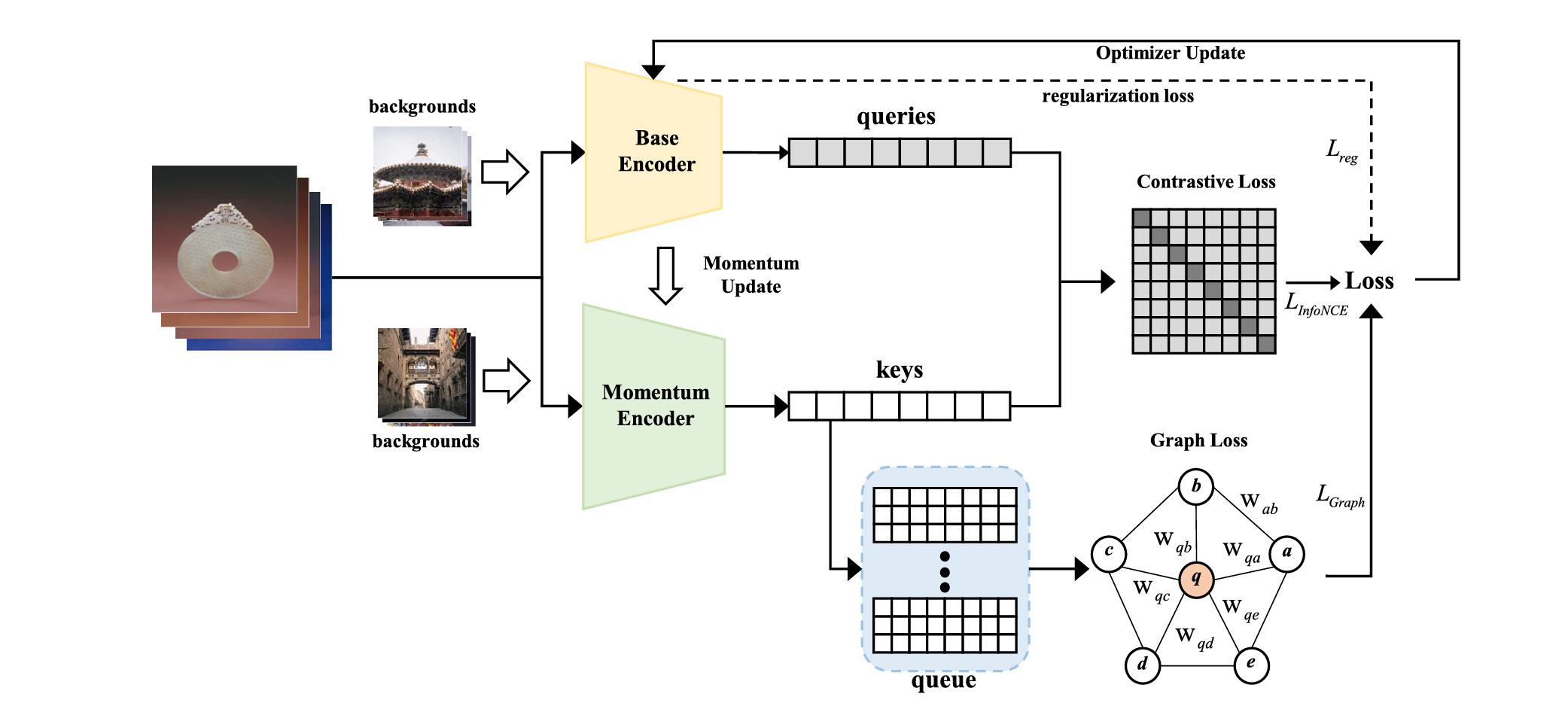
A Jade Image Retrieval Method Based on Self-Supervised Learning and Dynamically Composable Attention [Paper]
Wenjia Li, Shangxiao Qiao, Pengyu Zhu, Yixuan Zhao, Zhenyu Wang*
Pattern Recognition Letters 2026
📄 Pre-Prints
(†Equal contribution, *Corresponding authors)
💻 Internships
 Shanghai Artificial Intelligence Laboratory, China
Sep 2024 – Jun 2025
Position: Algorithm Intern, AI for Science Center, Research Tasks Department
Research Context
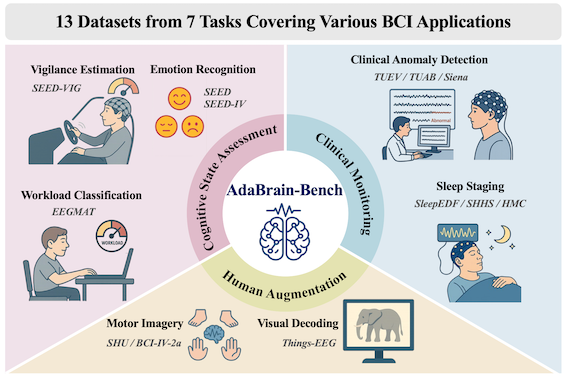
- With the rapid development of AI, brain–computer interfaces (BCIs) have attracted growing attention, inspiring interest in building direct information interaction systems between the human brain and computers or external devices. Researchers have focused on constructing universal foundation models for brain science based on EEG signals to improve generalization across brain decoding tasks. These models are typically trained on multiple large-scale datasets to enhance adaptability and robustness in diverse tasks.
- Proposed a comprehensive evaluation benchmark to assess state-of-the-art EEG foundation models across six key decoding tasks, covering health monitoring, cognitive and affective analysis, and brain–computer interaction. Responsible for preprocessing all EEG datasets, reproducing and fine-tuning EEG foundation models such as LaBraM and CBraMod, as well as manuscript preparation and figure creation.
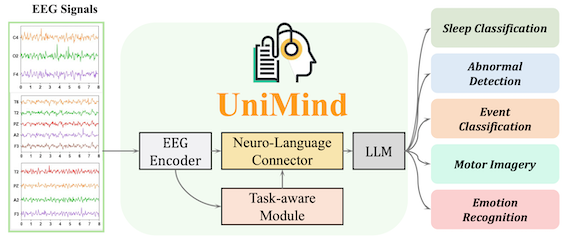
- Developed a universal EEG foundation model, UniMind, leveraging large language models (LLMs) to understand complex neural patterns, addressing the limitations of existing models in generalization across heterogeneous decoding tasks without task-specific fine-tuning. Responsible for constructing all EEG instruction datasets, model design and evaluation, as well as manuscript preparation and figure creation.
 Chinese Academy of Sciences, the Institute of Automation, China
Mar 2026 – present
Position: Algorithm Intern, National Key Laboratory for Multimodal Artificial Intelligence Systems
Research Context
- As digitalization and intelligent technologies continue to advance, time-series data have become ubiquitous in domains such as transportation scheduling, financial analysis, energy management, and industrial monitoring. Accurately forecasting future temporal dynamics is essential for risk warning, resource optimization, and intelligent decision-making, and has also driven the development of general-purpose time-series forecasting models and time-series foundation models.
- Developed GraphTime, a graph-enhanced time-series forecasting framework. GraphTime models dynamic dependencies among variables and jointly learns cross-variable interactions and temporal dynamics, thereby improving forecasting accuracy and generalization in complex multivariate scenarios. Responsibilities include model architecture design and implementation, data processing, comparative and ablation experiments, paper writing, and figure design. The research has been successfully deployed on the Daxing Airport Express of the Beijing Subway, providing technical support for intelligent railway operations and decision-making and enabling the translation of algorithmic research into real-world applications.
- Conducted research on multimodal time-series foundation models. Built upon general-purpose time-series foundation models such as Chronos-2 and incorporated heterogeneous information, including text and images, to learn more comprehensive temporal-semantic representations through cross-modal alignment and joint pre-training. The goal is to improve transferability and generalization across downstream tasks such as forecasting, classification, and anomaly detection. Responsibilities include multimodal dataset construction, model design and training, and downstream task evaluation.
💼 Entrepreneurship
- 2025.09 – Present, Beijing Beiqing Artificial Intelligence Technology Research Co., Ltd., Beijing, China
Position: Director & General Manager - In recent years, national and local governments have introduced policies promoting the integration of AI with traditional culture, supporting cultural inheritance, innovation, and dissemination. The State Council’s “Opinions on Deeply Implementing the ‘AI+’ Action” explicitly encourages AI applications in cultural creation and dissemination, promoting content that incorporates Chinese cultural elements and driving high-quality development of the cultural industry. Additionally, the “Beijing Action Plan for Technology Empowering Cultural Innovation (2025–2027)” focuses on breakthroughs in key technologies such as digital human interaction, advancing the intelligent upgrade of museums.
- Led the development of the “YiPaiJiShi(艺拍即识)” mini-program, overseeing product planning, front-end & back-end architecture design, and core algorithm optimization to enable scenario-based artwork recognition and automatic knowledge display. The platform promotes innovative applications of AI in Chinese cultural heritage, enhances user interaction, and contributes to digital preservation of traditional culture. The product has been deployed multiple times in Beijing’s 798 Art District, fostering the integration of culture and technology.